Propulsion research · Senior thesis
Adapting a UAV engine to run on ammonia.
For my senior thesis, I redesigned the cylinder head of a 70 cc gasoline engine and tested it on ammonia with hydrogen supplied by an ammonia cracker. The intended application is a generator for an electrically propelled UAV.
My work
Cylinder-head CAD, combustion simulation, manufacturing drawings, instrumentation, and laboratory testing.
Built and tested
A manufactured dual-spark head; cracker-assisted bench operation at about 2000–2500 rpm.
Test scope
Engine speed and cylinder pressure. Loaded power, efficiency, and flight performance remain unverified.
Engine conversion
Project brief
- 01 Measured Stock head, interfaces, chamber, and UAV envelope
- 02 Modeled Three ignition layouts in CONVERGE CFD
- 03 Manufactured Dual-spark stainless-steel head and sensor access
- 04 Bench tested Speed and in-cylinder pressure on cracker-assisted ammonia
Thesis responsibilities
My role
I owned the cylinder-head redesign and carried it from the stock engine through CAD, analysis, manufacturing, instrumentation, and engine testing, with support from my advisor and the university laboratory.
- Measured and 3D-scanned the original GTT70 head, then rebuilt the critical geometry in SolidWorks.
- Designed the approximately 17:1 chamber, dual-spark packaging, and in-cylinder pressure-sensor access.
- Extracted the internal fluid domain and built the two-stroke CONVERGE model.
- Prepared the manufacturing geometry and engineering drawing for the CNC prototype.
- Integrated the pressure-measurement chain and ran the bench test sequence with laboratory support.
Range-extender boundary
System architecture
The intended range extender uses an engine to turn a generator, which supplies electricity to the UAV propulsion system and buffer battery. This thesis tested the engine conversion on a laboratory bench.
The starting point was the GTT70, a 70 cc, two-cylinder, two-stroke gasoline engine. I retained the base engine and redesigned its cylinder head, ignition packaging, and pressure-sensor access.
Ammonia can be stored as a liquid and carries no carbon, but its low reactivity and slow flame propagation make it difficult to use in a small, fast spark-ignition engine. I investigated higher compression and alternative ignition layouts to help the mixture ignite and burn within the available cycle time. For the bench runs, a cracker converted part of the ammonia into hydrogen and nitrogen before the mixture entered the engine.
Mechanical design
Cylinder-head redesign
I reduced the combustion-chamber clearance volume to raise geometric compression from approximately 10:1 to approximately 17:1. The higher compression gives a hotter, denser charge at the end of compression, which helps a fuel that resists ignition.
I retained the original cylinder interface, fastener pattern, and sealing surfaces, and checked piston clearance and the installation envelope. I packaged two CM6 spark plugs and a Kistler pressure-sensor port inside the same compact head.
I used 304 stainless steel for the test article. During the initial single-spark head study, I applied a 20 MPa chamber-pressure load in ANSYS to screen static strength. The material choice favored repeated assembly, thread integrity, and chemical compatibility for a laboratory prototype. The tradeoff was a heavier head with lower thermal conductivity than the original aluminum part. A flight version would need further work on mass and heat rejection. The ANSYS analysis screened static strength; fatigue, thermal cycling, joint preload, and vibration were outside that analysis.
Ignition selection
CFD trade study
High-energy single spark
One ignition site, with the flame propagating outward through the chamber.
Glow-assisted ignition
A heated surface assists ignition, with combustion timing sensitive to the imposed surface temperature.
Dual spark
Two ignition sites reduce the distance each flame front must travel.
I extracted the engine's actual internal fluid domain and modeled piston motion, two-stroke port boundaries, local refinement, and detailed NH3/H2 chemistry in CONVERGE.
At 3000 rpm, I compared three ignition layouts with 20%, 10%, 5%, and 0% hydrogen by volume of the hydrogen/ammonia fuel blend, excluding air. I evaluated simulated pressure, heat-release rate, combustion timing, temperature fields, burn duration, and indicated work. CA10–90 is the crank-angle interval over which cumulative heat release rises from 10% to 90%.
Under these modeled conditions, the dual-spark layout retained more favorable combustion timing as hydrogen content fell, so I selected it for the prototype. Each modeled spark supplied 0.2 J: the dual-spark case therefore received twice the total spark energy of the single-spark case. This compared complete ignition layouts; it did not isolate the effect of spark location at equal total energy.
The 3000 rpm design cases used prescribed mixture and wall conditions. The bench used the stock ignition system at lower speed and load. I built a separate case at approximately 2500 rpm to compare pressure rise and approximate phase with the cracker-assisted runs.
Physical test sequence
Bench validation
Confirmed starting, hot operation, clearances, and pressure acquisition with the modified head.
Pure ammonia without the cracker did not ignite reliably in the existing engine configuration.
Later runs operated at approximately 2000-2500 r/min without gasoline or ethanol assistance.
The measurement chain combined a Kistler 6052C in-cylinder pressure sensor, Type 5018 charge amplifier, LeCroy WaveSurfer 3054Z oscilloscope, and PCAN monitoring.
The recorded outputs were engine speed and in-cylinder pressure traces. Generator-side coupling and alignment prevented reliable loaded measurements, so these runs did not establish brake power or efficiency.
The experimental plot shows baseline-corrected pressure rise rather than absolute cylinder pressure. Crank angle was estimated from the ignition signal, so the traces support pressure-rise and approximate timing comparisons. They were not used to claim measured heat-release rate, indicated work, or cycle-to-cycle stability.
Awards and honors
Recognition
Ranked 1st of 127
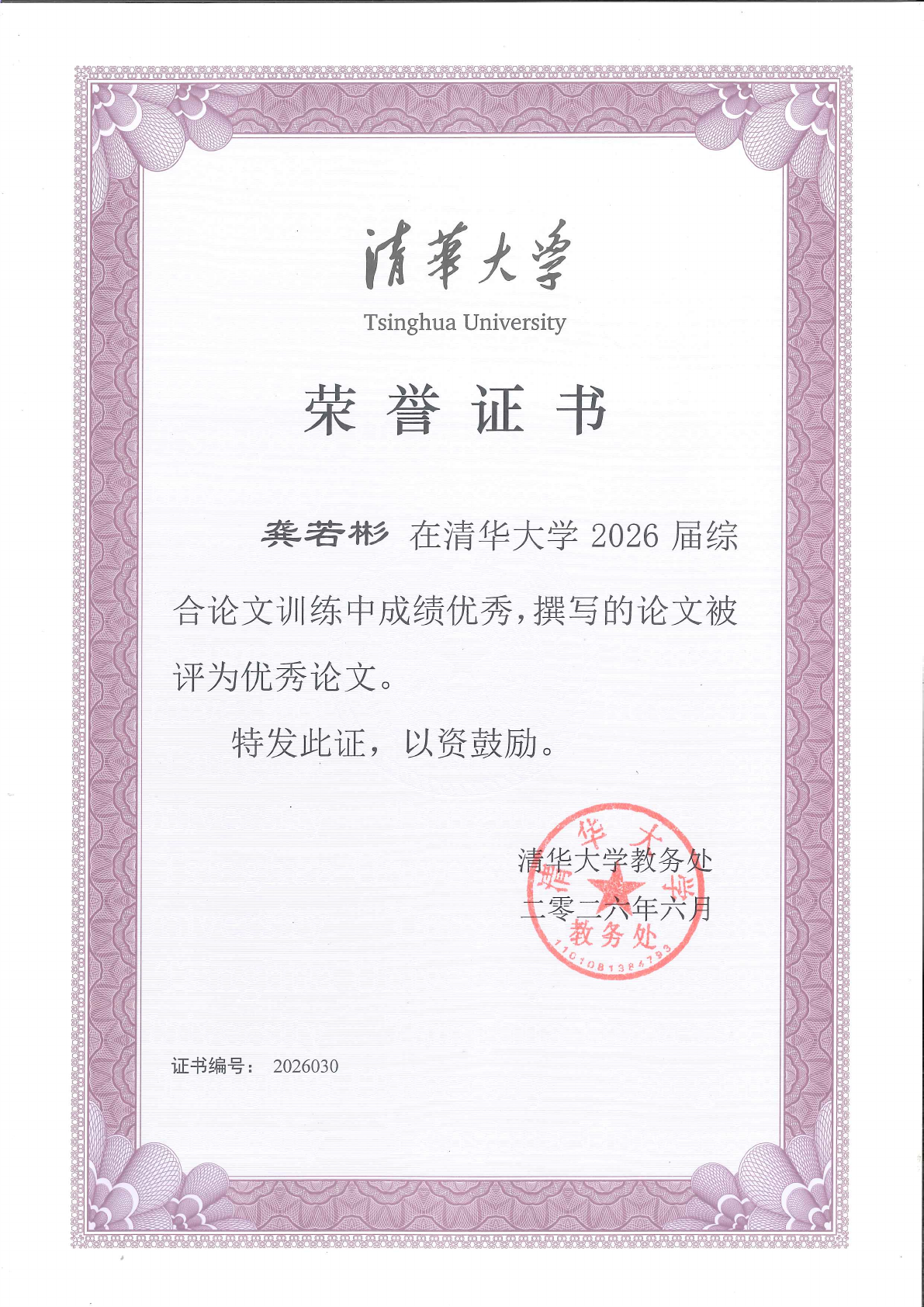
Tsinghua University Outstanding Undergraduate Thesis Award, top 3% of the Vehicle Engineering cohort.
First Prize
Tsinghua 44th Challenge Cup.
Second Prize
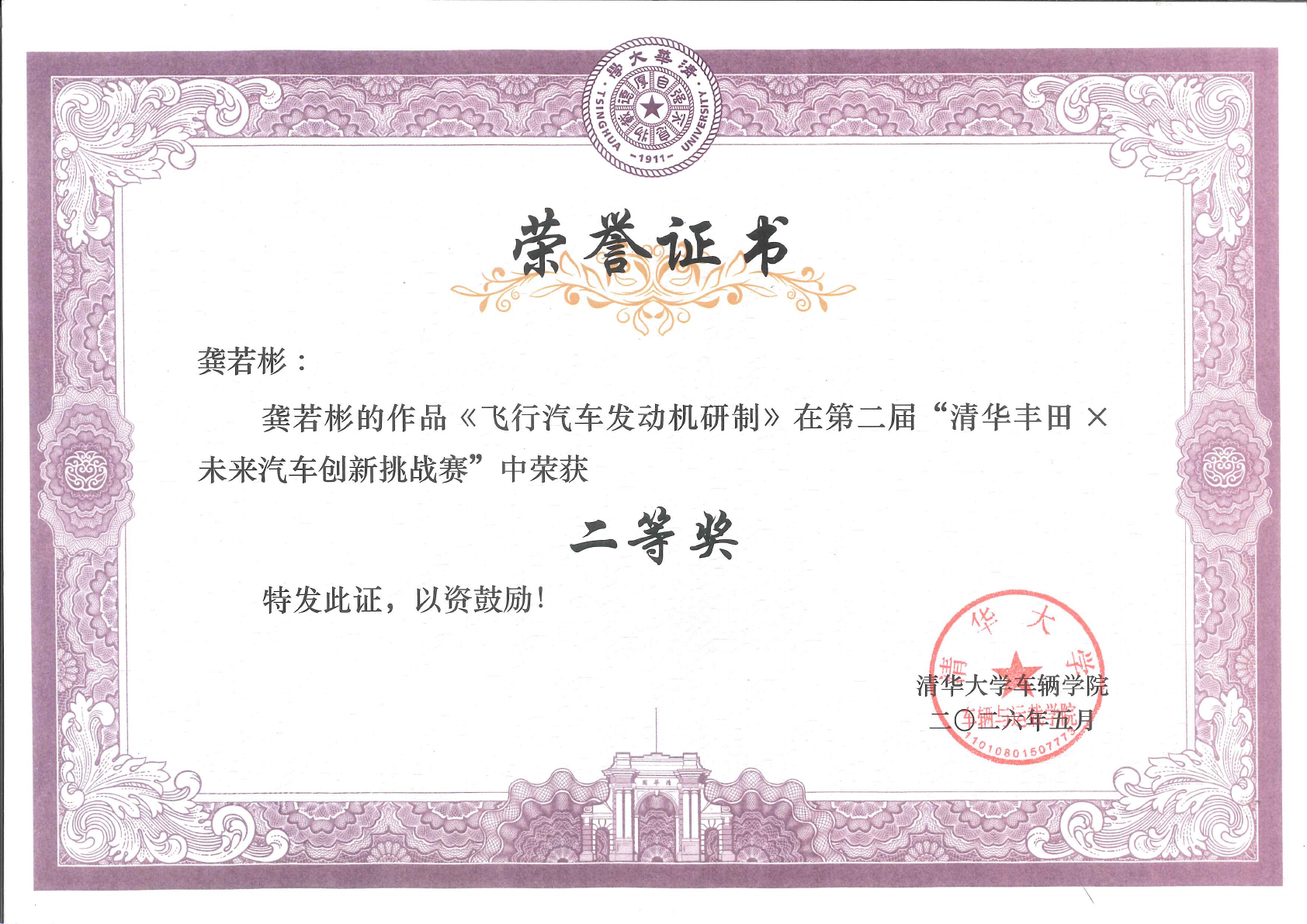
Tsinghua-Toyota Future Mobility Innovation Challenge.